Suichuan

Things to do in Suichuan

Search attractions or local attractions & tours
Search

Explore top experiences

Top 10 attractions in Suichuan

View all Attractions
Tanghu Hot Spring
No. 15 of Hot Springs Attractions in Jiangxi

Tanghu Hot Spring

3.5
4.7/5
176 reviews

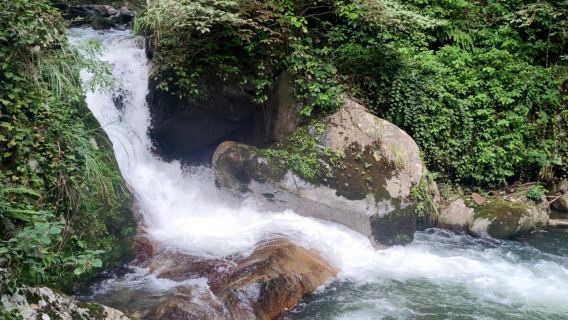
Tanghu Hot Spring: A Healing Theater in Nature's Geological Clock Nestled in a volcanic plateau, this hidden hot spring sanctuary resembles nature's own therapeutic laboratory. The mildly alkaline silicic springs emerge from the source, cascading through moss-covered basalt ravines to form seven terraced pools, each precisely maintaining a 2.3°C temperature difference. Unlike conventional hot spring resorts, it preserves traces of primal geothermal activity—during the predawn "spring awakening" around 5 AM, the mist carries faint whiffs of sulfur crystals reminiscent of sandalwood. The signature "rock therapy" is a must-try experience: Under the guidance of professional therapists, visitors can apply volcanic mud containing trace magnetite to specific joints, then soak in a 42°C whirlpool where water pressure and mineral components create a unique therapeutic combination. The "Moonlight Bathhouse," open only on the 7th day of each lunar month, features natural fluorite paving the pool floor that emits faint bioluminescence under specific moonlight conditions. The forest trail behind the hot spring area holds hidden surprises, featuring five geothermal observation points along the way. Carry a specialized thermometer to witness the dramatic temperature shift from 32°C to 67°C on the ground surface. Don't miss the "Geological Tea Hut" experience—brew local volcanic rock tea with 93°C spring water and watch the infusion transition from amber to jade green as it cools. The mineral steam room in the hot spring area is built using ancient techniques, blending seven local herbs with hot spring vapors. Its specially designed sloped ceiling allows condensation to drip into neck massage channels, creating a unique spa rhythm. The nighttime "Starlight Pool" features an astronomical telescope, where bathers might catch glimpses of the Orion Nebula playing with the misty reflections on the water's surface. Important notes: It is recommended to bring dark-colored swimwear to prevent mineral staining. The changing rooms provide heated rock loungers with underfloor heating. Temperature-sensitive visitors can opt for the constant-temperature hot spring pools during dawn hours when the concentration of dissolved radon gas in the spring water may reach its daily peak. The accompanying farming experience area grows volcanic ash tomatoes irrigated with hot spring water, where during harvest season you might witness the rare phenomenon of steam escaping from cracks in the fruits.

Suichuan · 40.7km from downtown
Orange Isle Scenic Area
No. 3 of Best Things to Do in Hunan Jiangxi Fujian Region

Orange Isle Scenic Area

9
4.6/5
13.7k reviews

Orange Isle Scenic Area is a narrow sandbar lying across the heart of the Xiang River in Changsha, stretching approx. five km. It faces Yuelu Mountain to the west and borders Changsha's old city to the east, surrounded by water on all sides. Named after the abundant orange trees planted on the isle, it was historically called Shuiluzhou. Formed by river alluvium, this sandbar has existed for over a millennium, where the "River and sky in evening snow" scenery was once among the Eight Views of Xiaoxiang. In 1925, the poem "Spring in a pleasure garden - Changsha" was composed here, with its iconic line "Alone I stand in the biting fall, watching the Xiang River flow north past Orange Isle's head," which made this riverine landmark widely renowned. The highlights of the visit are concentrated at the islet's head: A granite art sculpture over 30 m tall, modeled after the 1925 youth image, stands facing the river as Changsha's highly recognizable landmark. Nearby, the Questioning Heaven Platform extends toward the river center, where leaning on the railing reveals the mighty Xiang River flowing northward, with Yuelu Mountain and the city skylines on both banks facing each other across the water. The Songju Pavilion, white marble poetry stele, and the 200-year-old ancient phoenix tree at the islet head are all in this area. Heading north from the islet head, a hundred-acre orange orchard bears golden fruits in fall, while bamboo groves, peach orchards, plum gardens, and osmanthus groves take turns showcasing seasonal flora. The historic Zhuzhang Ferry (where Zhu Xi and Zhang Shi once crossed the Xiang River for lectures) and the Huxiang Culture Exhibition Hall are scattered along the way. At the islet's tail, the reconstructed Jiangshen Temple and Gongji Tower area was precisely where ancients admired the "River and sky in evening snow" scenery. The island is long and narrow, making round-trip walks quite tiring. A sightseeing train is available for transportation, with multiple stops along the way for hopping on and off. Travelers with limited time are advised to head straight to the island's tip to see the sculpture and river views, then stroll leisurely along the riverside path. At dusk, watching the sunset over the Xiang River and seeing the lights gradually illuminate both shores from the island's tip is especially worth setting aside time for.

China · Changsha
Hunan Museum
2026 Asia 100 - Best Things to Do

Hunan Museum

8.8
4.8/5
16.3k reviews

Hunan Museum is a relatively large history and culture museum in Hunan Province, and among its collections, the artifacts unearthed from the Mawangdui Han Tombs are particularly representative. "The Changsha Mawangdui Han Tombs Exhibition" is the museum's permanent exhibition, presenting in a concentrated way the precious artifacts unearthed from three Western Han tombs. One of the most striking exhibits in the exhibition is the plain silk unlined robe with straight-cut front, as thin as cicada wings and weighing less than 50 grams, whose weaving technique is astonishing. In addition, visitors can see well-preserved printed silk padded robes, fine and elegant embroidery, brightly glossy painted lacquerware, and an exquisite T-shaped painted silk painting. More than 100,000 characters of silk manuscripts were unearthed from Tomb No. 3, among which are many lost texts long since gone from circulation, covering fields such as philosophy, history, astronomy, and medicine. The "Topographic Map of the Southern Part of the Changsha Kingdom," also from Tomb No. 3, was drawn using techniques broadly similar to those of modern maps and holds important value in the study of ancient maps. The well-preserved body of Lady Xin Zhui unearthed from Tomb No. 1 has survived intact for more than two thousand years and is another major highlight of the exhibition. The museum also features permanent exhibitions such as "Hunan People: A Historical and Cultural Exhibition of the Three Xiang Regions," displaying collections including Shang and Zhou bronzes, ceramics from famous Hunan kilns, and Ming and Qing calligraphy and paintings, presenting the historical and cultural threads of Hunan from different dimensions. The Mawangdui Han Tomb Exhibition and the Three Xiang Historical and Cultural Exhibition together form the museum's two core exhibitions, and are well worth setting aside ample time to view in detail.

China · Changsha
Tengwang Pavilion Tourist Area
2026 Global 100 - Night Attractions

Tengwang Pavilion Tourist Area

8.7
4.5/5
30k reviews

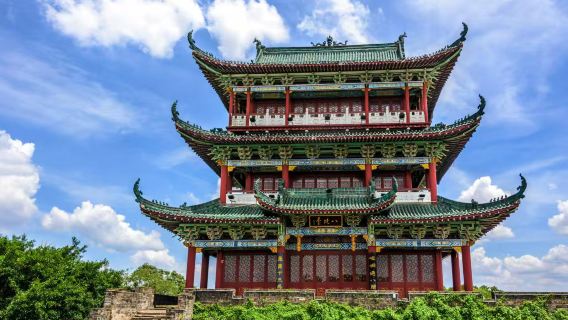
Tengwang Pavilion Tourist Area is located on the east bank of the Gan River in Nanchang, with the riverside Tengwang Pavilion as its centerpiece. Originally built in the fourth year of the Yonghui era of the Tang Dynasty by Li Yuanying, Prince of Teng and son of Emperor Gaozu of Tang, it gained eternal fame through Wang Bo's "Preface to Tengwang Pavilion." Alongside the Yellow Crane Tower and Yueyang Tower, it is hailed as one of the "Three Great Towers of Jiangnan." Historically destroyed and rebuilt nearly thirty times, the current structure is a Song-style replica completed in 1989, designed based on Liang Sicheng's reconstruction sketches. With its green tiles and layered eaves, it remains a landmark of Nanchang to this day. The main pavilion follows a "three visible, seven concealed" layout: appearing as a three-story structure with encircling corridors from the outside, while actually containing seven interior floors—nine levels including the two-tiered base symbolizing ancient city walls. Turquoise-roofed galleries extend north and south from the base's flanks, connecting at their ends to auxiliary pavilions named "River-taming" and "Greenery-embracing," forming a mountain-shaped silhouette with the main tower. Below, an artificial lake and the nine-bend wind-and-rain bridge add classical garden charm to the majestic architecture. Each floor of the pavilion offers something remarkable. The white marble relief "A timely wind delivers Tengwang Pavilion" in the first-floor preface hall depicts the legend of Wang Bo riding the wind to compose his famous preface. The second-floor mezzanine features the long scroll painting "Gallery of eminent figures," gathering Jiangxi's historical luminaries like Tao Yuanming, Ouyang Xiu, Wang Anshi, and Tang Xianzu in one artwork. The third-floor mural "Linchuan dream" recreates Tang Xianzu's staging of "The peony pavilion" here. The fourth-floor "Land of wonders" painting compresses Jiangxi's iconic landscapes—Mount Lu, Sanqing Mountain, Dragon-Tiger Mountain, and Poyang Lake—into a single masterpiece. The fifth floor is the highlight for panoramic views: its central hall displays a bronze tablet inscribed with Su Dongpo's calligraphic version of "Preface to Tengwang Pavilion," while the east hall exhibits a scale model of the pavilion. Strolling the veranda offers sweeping views of the Gan River and modern skyline across the water. The top floor bears the plaque "Ninth heaven," with its west hall housing an antique-style theater flanked by replica ancient instruments like chime bells and stone chimes. Above, spiral-arranged bracket sets adorn the caisson ceiling, and between the double eaves hangs Su Dongpo's gilded "Tengwang Pavilion" plaque. After descending from the main pavilion, take time to explore the garden area: the square in front of the pavilion, the grand Song-style archway, the antique street lined with calligraphy and antique shops, and the small Suzhou-style garden Fuchang Garden with its lake reflections and bridge views—perfect for slowing your pace. To experience the poetic scene of "a solitary wild duck flying with the sunset glow, while the autumn water blends with the vast sky," an evening ascent to the pavilion is ideal. The fifth-floor corridor offers an expansive view, making it a prime spot to admire the sunset over the Gan River.

China · Nanchang
Jiangnan Songcheng Historical And Cultural Tourism Area
No. 1 of Best Things to Do in Ganzhou

Jiangnan Songcheng Historical And Cultural Tourism Area

7.7
4.6/5
730 reviews

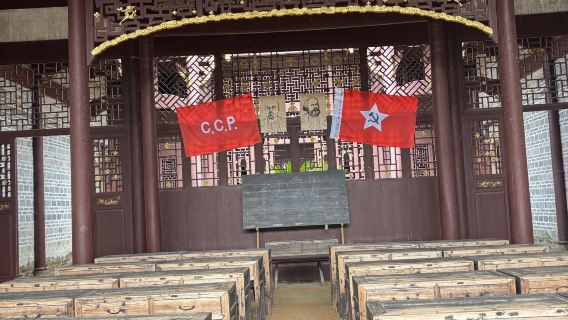
Jiangnan Songcheng Historical and Cultural Tourist Area is located in Hetao Old Town, Zhanggong District, Ganzhou City at the intersection of Zhangjiang River, Gongjiang River and Ganjiang River. It is a national 4A-level scenic spot. Covering an area of 143 mu, it includes five historical and cultural blocks (Yugutai, Yao Yaqian, Zaoer Lane, Nanshi Street, and Ciguling) and one block with traditional features (Xingannan Road) and the area where cultural preservation units are located. Within the block, there are Yugu Terrace, Song City Wall, Bajing Terrace, Chiang Ching-kuo's Former Residence, and the Site of the Special Committee of the Communist Party of China, etc., including Yangming Academy, Guangdong Guild Hall, Former Residence of Li Zhengdao (Nobel Prize Winner), Zhang Leping (famous cartoonist) Home, the former residence of the author of Sanmao Wanderings), Huichang Xue Mansion, Anyuan Xue Mansion, Longnan Xue Mansion, Jiuhua Ancient Pavilion and other historical buildings. Since the operation of the Jiangnan Songcheng project, the establishment of a national 4A-level tourist attraction has been completed within 3 months, and it has won the top ten cultural and tourism integration demonstration projects in Jiangxi Province, the 2020 provincial modern service industry cluster, the first batch of provincial night cultural tourism consumption clusters, Jiangxi Provincial Tourism and Leisure Block, Provincial Commercial Block Renovation Pilot Block and many other honorary titles were selected as the first batch of Ganzhou Intangible Cultural Heritage Town and the third batch of Zhanggong District Youth Comprehensive Practice Base. Among them, the intelligent detection and management system for the protection of historical and cultural blocks in Ganzhou City, "Song City on the Cloud", has also become a typical case of cultural and tourism informatization development in Jiangxi Province.

Ganzhou · 64.9km from Suichuan

Experiences you can't miss in Suichuan

Suichuan Today's weatherClear 11-20℃
Suichuan weather for the next 2 days11/12: 14-18℃, 11/13: 16-23℃

Free things to do in Suichuan

What travellers say about Suichuan

user-avatar
M27***h513 June 2025
5.0
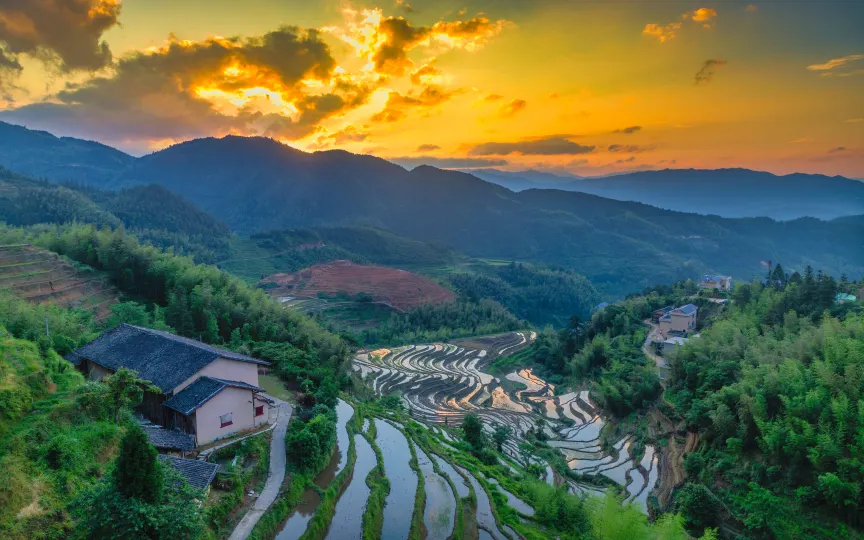
5月长假女儿带我和家人一起去桃源梯田旅游,当时去的时候是晚上,这个夜景灯光特别的美,在月亮观景台看了灯光秀,露天舞台玩了篝火晚会,虽然很热,但是很开心!

Taoyuan Terraces

user-avatar
charles11 August 2020
5.0
There are not many people in the scenic area, mainly waterfalls, and most of the mountain is covered with green bamboo and lush vegetation. There are not many attractions in the scenic area, and there is basically no commercial atmosphere. The air quality is particularly good, just like a natural oxygen bar.

Baishuixian Scenic Area, Suichuan County

user-avatar
大圣塑料光纤18 October 2020
5.0
Good water resources! Real hot springs, fresh air, no service. The hardware facilities are not perfect. The staff is very polite and courteous. The boss is too stingy, and we can't use more than one dry bath towel. We knew this and brought our own bath towels. The scenery is good, the experience is good, worth recommending, interesting and fun,

Tanghu Hot Spring

user-avatar
gz伊妹儿14 July 2021
5.0
The scenery of Wuzhi Peak is so beautiful. It is named after the mountain. It is a natural oxygen bar and a pure natural scenery. You can see the beautiful scenery from a high place. It is refreshing and unforgettable. It is a good choice.

Finger Peak

user-avatar
YazonDinAlt23 October 2026
4.0
Orange Island is a bit of a mixed experience, and I'm honestly not entirely sure whether I'd consider it a must-visit in Changsha.It's a large, green, and pleasant park, with beautiful riverside views and plenty of space for walking. If you enjoy places with historical significance or simply want to experience a different side of the city, it's definitely worth considering.Most visitors seem to take the sightseeing train to the southern end of the island, where the famous Mao Zedong statue is located. That's also where you'll find plenty of people taking photos, so don't expect a particularly quiet experience.The main downside is that visiting the island takes quite a bit of time, especially if you want to explore it properly. And while it's certainly a nice place, I'm not sure the experience justifies spending several hours here if you have a limited amount of time in Changsha and other places you'd like to see.On the other hand, if you're simply looking for a relaxing walk through a green park, with opportunities to stop by the river and enjoy the scenery, it's a lovely option.Overall, I'd say it's worth visiting if you have some extra time or are particularly interested in Chinese history. Otherwise, I wouldn't necessarily put it at the very top of your Changsha itinerary.

Orange Isle Scenic Area

user-avatar
Anonymous user6 November 2026
5.0
Director Xu's explanations were highly professional, vivid, patient, and captivating. He focused on explaining all the key exhibits, connecting them with historical anecdotes and other details to make them easier to understand. Highly recommended.

Hunan Museum

user-avatar
住在湖边的人Lynne10 November 2026
5.0
Originally built in the Tang Dynasty and rebuilt several times during the Song, Yuan, Ming, and Qing Dynasties, the pagoda standing today is a reconstruction from 1989 based on manuscripts and historical documents left by Mr. Liang Sicheng. Although it is no longer the ancient pagoda from which Wang Bo once gazed into the distance, the river flows on, and the mountains remain unchanged. Climbing the pagoda is not for reminiscing about the past, but simply to share the same sky and earth with that young man from a thousand years ago amidst the rising winds and surging clouds—in that instant, you understand what it means to "fly the setting sun and the lone wild goose together, the autumn water and the vast sky are of one color." The essence lies not in the pagoda itself, but in the moment of ascending it.

Tengwang Pavilion Tourist Area

user-avatar
Anonymous user7 November 2026
5.0
Chiang Ching-kuo's former residence is a retro Russian-style building in the shape of a convex character. It displays many authentic old photos, artifacts used by Chiang Ching-kuo, and various related historical facts, making it very meaningful for commemoration. It is located in the Yugutai area of ​​Songcheng.

Jiangnan Songcheng Historical And Cultural Tourism Area

Popular cities near Suichuan

Frequently asked questions

As of 12 November 2026, the reference price for day tours and activities in Suichuan is around MYR 698.57 – MYR 978. Rates vary by duration, group size, transport, tickets, meals, and any special admission requirements. Before you book, please confirm the billing currency and whether the price is quoted per person or per group.

Get help anytime, anywhere within 30 secondsContact customer support

Change and cancellation policies vary by attractions and tours. Please check the product details page for more information.

Ticket prices may vary between weekdays and weekends, as well as during peak and off-peak seasons. When booking with Trip.com, you can also use Trip Coins to get extra savings. For more tips on booking discounted tickets, please visit Trip.com for the latest information.