
Things to do in Sintra
Explore top experiences
Top 10 attractions in Sintra


Pena Park
Pena Park is a vast royal forest garden surrounding Pena Palace, spread across the heights of Sintra mountain. Built in the mid-19th century by Portuguese King Ferdinand II concurrently with the palace, it covers over 200 hectares of undulating terrain with dense woods. The crisscrossing garden paths form a labyrinth connecting stone bridges, grottoes, fountains, and floral pergolas. Combined with the frequent mountain mists, strolling here feels like stepping into a fairy-tale forest. Viewed from the palace side, the entire green expanse spreads like an ocean across the slopes, with the red-and-yellow palace towers as the focal point. This garden embodies distinct romanticism - the king ordered exotic trees planted from distant continents, including North American redwoods, Chinese ginkgos, Japanese cryptomerias, and magnolias. In the "Queen's fern valley," Australian and New Zealand tree ferns thrive densely along the stream. The lake valley features duck houses built like miniature castles on ponds, one mimicking the Moorish castle. A knight-themed "Warrior statue" by sculptor Rusconi stands in the woods, while the Swiss-style "Countess cottage" on the western side, decorated with cork and painted wood textures, was built for the king's opera-singer second wife, surrounded by camellias, rhododendrons, and granite boulders. Visiting tips: Wear comfortable shoes and allocate half a day due to the vast area with many slopes and forks. Don't just make a round-trip to the palace - explore deeper paths to quieter, photogenic spots like the lake valley, fern garden, and countess cottage. Spring brings particularly vibrant colors when camellias bloom.Sintra · 1.7km from downtown

National Palace of Pena
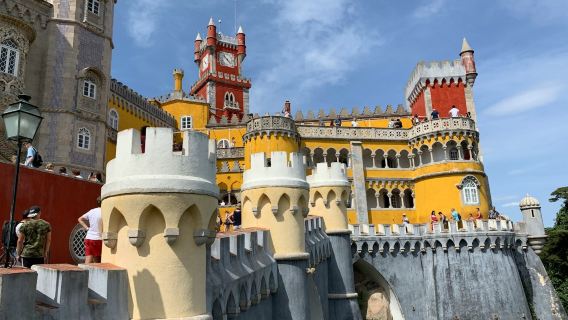
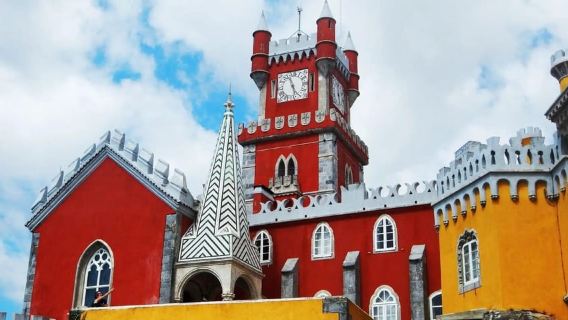
The National Palace of Pena is a royal retreat, its dazzling, peculiar, and ornate appearance resembling a fairytale castle. The palace itself is an eclectic mix of architectural styles, combining Gothic, Renaissance, Moorish, and Manueline (the architectural style during the reign of King Manuel I of Portugal). It stands as the brainchild of Ferdinand of Saxe-Coburg-Gotha, the husband of 19th-century Portuguese Queen Maria II. Not only is it a Portuguese national monument, but also one of the country's seven wonders. Perched atop a hill in the São Pedro de Penaferrim parish of Sintra near Lisbon, it is clearly visible from the city on clear days. In 1995, it was designated a UNESCO World Heritage site as part of the cultural landscape of Sintra. Today, it is frequently used for state events by the Portuguese president and other government officials. During the Middle Ages, this site housed only a small chapel dedicated to Our Lady. In 1493, King João II and his wife visited, and his successor Manuel I later built a monastery here, which was reduced to ruins after the 1755 Lisbon earthquake. Ferdinand II purchased the ruins and surrounding land, commissioning German engineer Baron Wilhelm Ludwig von Eschwege to design a palace blending Gothic, Manueline, Moorish, and Renaissance elements. Construction began in 1842 and was completed approx. 1854, making it one of Europe's finest examples of Romanticist architecture.Sintra · 1.9km from downtown
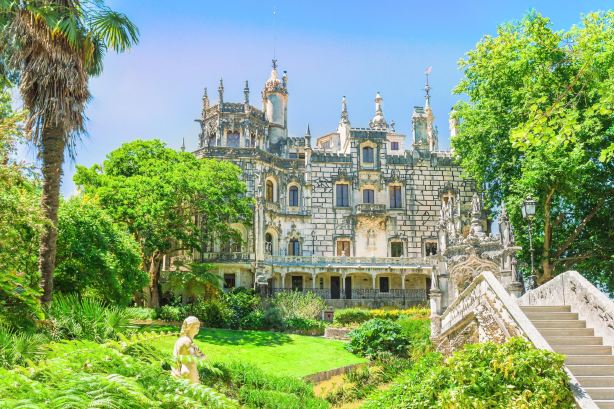
Quinta da Regaleira
Quinta da Regaleira is located near the historic center of Sintra in Portugal. As part of the cultural landscape of Sintra, it is listed as a UNESCO World Heritage site and is one of the main tourist attractions in Sintra. Quinta da Regaleira includes the romanticist Regaleira Palace, Regaleira Chapel, and a park featuring lakes, grottoes, wells, benches, fountains, and numerous exquisite structures. This estate is also known as "The palace of Monteiro the Millionaire." In the center of the manor stands a small curved city wall adorned with carvings of divine creatures. Passing through the wall and traversing a 10 m-long cave leads to an inverted tower-style deep well called the "Well of revelation." This well was not built for drawing water but for ceremonial purposes: its approx. 27 m-deep walls contain nine spiral stone steps—some say representing the nine founders of the Knights Templar, while others associate them with the nine circles of hell in Dante's Divine Comedy. The well's floor also bears a compass pattern with the Templar cross. Initiates were reportedly blindfolded and armed with swords as they descended the spiral staircase to the well's bottom, then groped through dark tunnels toward light. Both the upper and lower sections of the well connect to an underground tunnel network leading to the Labyrinth cave, Chapel cave, and waterfall lake. Entering through the Guardian's Gate, explorers eventually emerge from the well's midsection—the entire experience resembling a labyrinthine adventure. The garden also houses an "Unfinished well," featuring straight ladders linking circular platforms, contrasting sharply with the spiral staircase design of the Well of revelation.Sintra · 1.4km from downtown

Cape Roca
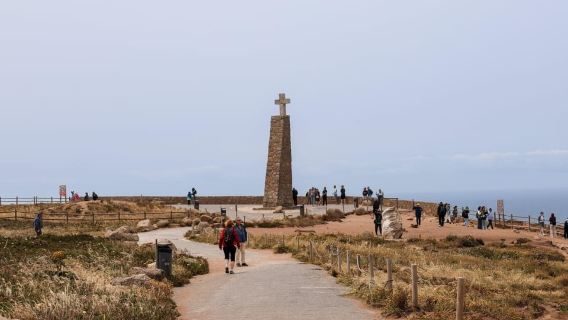
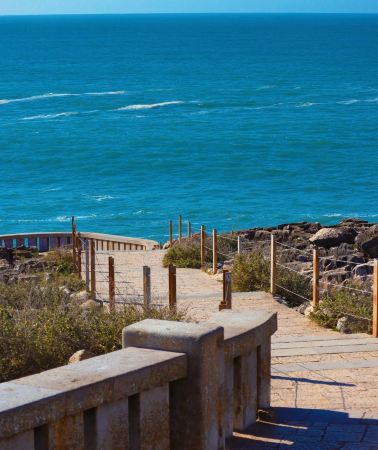
Cape Rocais located at the western end of the Sintra Mountains in Portugal, part of the Sintra-Cascais Natural Park, and is the westernmost point of continental Europe. It is approx. 140 m above sea level, with steep cliffs plunging into the Atlantic Ocean. Standing on the cliff top, you can enjoy a panoramic view where the sea meets the sky. A stone cross monument stands on the edge of the cliff, inscribed in Portuguese with the famous line by the 16th-century Portuguese poet Luís de Camões: "Where the land ends and the sea begins." Not far away is an 18th-century lighthouse that guides sailors along the windy and rough Atlantic coast. Walking along the cliff-top trail, you will see the endless ocean on one side and cliffs dropping vertically into the sea on the other, with golden light covering the sea at sunset. Admiring the magnificent Atlantic seascape and the sunset glow, and visiting the stone cross monument and the historic lighthouse are the classic and popular highlights of this destination.Sintra · 10.5km from downtown

National Palace of Sintra
The National Palace of Sintra is located in Sintra near Lisbon, Portugal. Construction began under King João I and was not completed until the reign of Manuel I in the 16th century. It is one of Portugal's best-preserved medieval royal palaces, continuously inhabited by royalty from the early 15th century to the late 19th century. The architecture features layered Gothic, Moorish, and Manueline styles, with its most recognizable landmark being two white conical chimneys over 30 m tall resembling a pair of upright bull horns, visible throughout the old town. Before Portugal became a republic, the palace served as the king's summer residence. It houses many distinctive rooms, including the grand Swan Hall adorned with exquisite decorations and a ceiling depicting 27 vividly posed swans. Other notable spaces include the Mermaid Hall with azulejo tilework, the Chinese Room displaying an ivory pagoda, and the Heraldic Hall featuring beautiful tile murals and noble coats of arms. As part of the cultural landscape of Sintra, it is designated a UNESCO World Heritage site.Sintra · 971m from downtown

Moorish Castle
The Moorish Castle is located on a hilltop in the parish of Santa Maria e São Miguel in Sintra. As a Moorish-style castle in Europe, it faces the Pena Palace across the valley and has become a major tourist attraction in Sintra. The Moorish Castle is a hilltop fortress built during the Moorish rule of the Iberian Peninsula (8th to 9th century AD). After the conquest of Lisbon in 1147, it came under Portuguese control. Subsequently, the town gradually moved downhill, and the castle slowly fell into ruin. It was not until the 19th century, when King Ferdinand II oversaw its restoration, that the romantic ruins we see today—a blend of crumbling walls intertwined with trees and vines—were preserved. The middle section of the steps collapsed long ago. Despite this, people still say the towering structure takes one's breath away. Climbing the 300 m-long walls offers a panoramic view of the surrounding landscape, while inside the walls, nature has reclaimed the collapsed buildings. For Chinese visitors seeing the castle for the first time, their initial impression is that the Moorish Castle resembles the Great Wall of China—winding and dotted with multiple watchtowers. Perched on the high-altitude hilltop of the Sintra Mountains, the castle is surrounded by walls hundreds of meters long, which lost their military defensive purpose as early as the 15th and 16th centuries. After a challenging climb, visitors can reach the top of the castle, where the Portuguese flag stands tall. From the castle's heights, one can enjoy breathtaking views of the vast Atlantic Ocean in the distance and the charming town of Sintra. On clear days, visitors can also catch sight of Ericeira and Mafra.Sintra · 1.3km from downtown

Jerónimos Monastery
The Jerónimos Monastery is located in Belém. This grand white structure is the most prominent landmark of this port city, and together with the adjacent Church of the Order of St. Mary, it represents a masterpiece of Portuguese Manueline architecture. In 1983 with nearbyBelém TowerAlong with being listed as a UNESCO World Heritage site, the Jerónimos Monastery is also the final resting place of explorer Vasco da Gama. A glorious history. Construction of the Jerónimos Monastery began in 1501 under King Manuel I to commemorate da Gama's historic voyage, taking nearly 100 years to complete. The church and monastery's connected walls stretch over 100 meters, occupying almost the entire street. This grandeur reflects Portugal's unrivaled maritime dominance in its heyday. The Jerónimos Monastery lacks a sufficiently open space in front for capturing a full panoramic view, but there's no need to fret—the exquisite carvings on its exterior walls are captivating enough to warrant prolonged admiration. The Virgin Mary holding the infant Jesus and the lively angels appear so lifelike they seem imbued with vitality. Exquisite carved decorations. The southern portal of the Jerónimos Monastery is particularly ornate, standing two stories tall with numerous intricate reliefs. The central spandrel features the coat of arms of Manuel I, while the arch's upper reliefs depict scenes of St. Jerome removing a thorn from a lion's paw and St. Jerome in the desert, all carved with astonishing realism and craftsmanship. Though less elaborate than the southern portal, the main entrance is equally distinctive, with carvings above the arch showing the Nativity scene and statues of Manuel I, the Virgin Mary, St. Jerome, St. John, and other saints flanking the doorway. The Jerónimos Monastery's interior is spacious and hallowed, with towering Gothic vaults in the main hall. The central altar is adorned with gold and green carvings, while a nearby altar holds a statue of St. Jerome made of crimson-glazed ceramic. The Church of the Order of St. Mary. Adjacent to the monastery, the Church of the Order of St. Mary is also well worth visiting. Upon entering, one immediately sees da Gama's sarcophagus, while on the opposite side lies Portuguese poet Luís de Camões, whose works represent the pinnacle of Portuguese Renaissance literature. The chapel is lavishly decorated, with its massive transverse nave roof in front of the main altar—supported without any pillars—considered an engineering marvel of the Middle Ages and long hailed as a masterpiece. The second floor houses a crucifixion figure, and the elegant cloisters offer a panoramic view of the Jerónimos Monastery's courtyard, showcasing distinctive Portuguese charm—a perfect spot to pause and appreciate.Lisbon · 19.1km from Sintra

Sintra-Cascais Natural Park
Sintra-Cascais Natural Park is located in the western part of the Lisbon region, Portugal, spanning the Sintra mountains and the coastal area of Cascais. It is a nature reserve that blends landscapes of mountain forests, countryside, dunes, and the Atlantic coast. It covers an area of approx. 145.8 square kilometers, with terrain extending from the Sintra Mountains, which reach a height of approx. 528 m, down to sea level, creating a rich and diverse natural environment. The mountains are covered with dense forests and shrub vegetation, with trails, rock formations, and viewpoints scattered throughout the woods. The coast features towering cliffs, sea-eroded landforms, beaches, and dunes. The park also includes coastal areas such as Guincho Beach and Adraga Beach, which are suitable for walking, sightseeing, surfing, and windsurfing.Sintra · 4.4km from downtown

Belém Tower
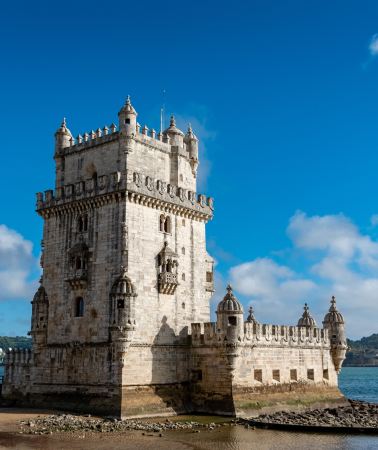
Belém Tower is a classic landmark of the Portuguese harbor and a symbol of Lisbon, witnessing countless voyages and departures, returns and reunions of ships during the Age of Discovery. This fortress was commissioned by King Manuel I and designed by military architect Francisco de Arruda, built between 1514 and 1520. It served both as a stronghold guarding the river mouth and a ceremonial gateway for explorers embarking on or returning from voyages. Originally standing isolated on a rocky outcrop in the river, it has since become connected to the mainland due to the riverbank's gradual expansion. The tower and irregular hexagonal bastion, constructed with Lisbon's local cream-colored limestone, are masterpieces of Manueline style: stone-carved ropes wind around the tower, while knots, crosses of the Order of Christ, armillary spheres, and reliefs of flora and fauna adorn its surface. Particularly striking is the stone rhinoceros on the bastion's turret base, modeled after the actual rhino brought from India to Lisbon in 1515 via new sea routes—later gifted to the Pope—and immortalized in Dürer's famous woodcut. Over the centuries, the site functioned successively as a customs house, prison, telegraph station, and lighthouse. In 1983, it was inscribed on the UNESCO World Heritage list alongside the nearby Jerónimos Monastery. The stone rhinoceros at the base stands out as a tribute to Portuguese explorers' overseas achievements. At sunset, Belém Tower takes on a special charm, and strolling along the harbor while enjoying the sea breeze makes for a delightful experience. barrier After crossing the drawbridge and passing through the main entrance, you arrive at the bastion of Belém Tower. The wall features 16 emplacements for cannons to defend against enemies. At the center of the roof, there is a Gothic-style rectangular skylight that serves as a ventilation shaft for the bastion, allowing the smoke from cannon fire to dissipate quickly. Beneath the bastion's floor are several storage rooms, with the largest one accessible via the staircase on the northern side. Platform To the right of the main entrance of Belém Tower, a steep staircase leads to the polygonal platform at the top of the bastion, with a sentry box at each corner featuring observation windows and pepperbox-shaped roofs. At the center of the platform, a railing encircles the courtyard below, with a statue of Our Lady of Victory placed on its southern side. From the bastion platform, you can admire the southern facade of Belém Tower up close, where the balconies and railings are exquisitely decorated with stone carvings. Particularly striking is the stone-carved shield of King Manuel I, adorned with lifelike floral motifs above it. Tower top Ascend the stairs on the right side of the platform to enter the interior of Belém Tower. Follow the spiral staircase to reach the top platform, where you can enjoy the beautiful scenery of Lisbon's harbor.: The Tagus River, Jerónimos Monastery, Monument of the Discoveries, the Christ the King statue on the opposite bank, the 25th of April Bridge, and more are all in full view. The occasional sailing boats drifting on the sea also form a beautiful sight.The wind is strong on the top platform of Belém Tower, please take precautions against wind and keep warm.Lisbon · 19km from Sintra

Cape Roca Lighthouse
Cape Roca Lighthouse is located at Cape Roca in the municipality of Sintra, Lisbon District, Portugal. It is an important landmark of the coastal scenery at the westernmost end of the European continent and one of Portugal's historic navigational lighthouses. The tower is primarily white with a red railing at the top, making it stand out against the backdrop of dark rocks, green vegetation, and the vast Atlantic Ocean. Built on a coastal highland, it is surrounded by steep cliffs, a rugged rocky coastline, and open viewing areas, offering distant views of the sea, the coastline, and the Sintra mountain landscape. It is affected by sea winds all year round; the view is expansive on clear days, while it presents a different coastal atmosphere on cloudy days or when the waves are rough. In addition to its function of guiding maritime navigation, it also features a visitor interpretation center that provides information on maritime safety.Sintra · 10.3km from downtown
Experiences you can't miss in Sintra
Featured Day tours in Sintra
View all Day tours
4.6/5
· 2.2k reviews· 90 bookedFree cancellation
Book now for today
91.9% of travelers recommend
5% off
Limited-time sale
FromINR 2,270.79INR 2,390.31

4.7/5
· 3 reviews· 34 bookedFree cancellation
63 travellers saved
FromINR 9,089.07

FromINR 11,095.75

5.0/5
· 3 reviewsFree cancellation
Book now for tomorrow
FromINR 15,404.19




Free cancellation
Book now for tomorrow
FromINR 63,282.14
Featured Food & drink in Sintra
View all Food & drink

5.0/5
· 3 reviewsFree cancellation
Book now for today
5% off
Limited-time sale
FromINR 8,982.24INR 9,454.99


5.0/5
· 1 reviewFree cancellation
Book now for today
FromINR 8,908.65
4.8/5
· 16 reviewsFree cancellation
Book now for today
5% off
Limited-time sale
FromINR 7,549.11INR 7,946.44
Free cancellation
Book now for tomorrow
5% off
Limited-time sale
FromINR 18,165.31INR 19,121.38

4.8/5
· 17 reviewsFree cancellation
Book now for tomorrow
FromINR 23,764.62

Featured Cultural experiences in Sintra
View all Cultural experiences
5% off
Limited-time sale
FromINR 5,046.20INR 5,311.79
Free cancellation
Book now for today
20% off
Limited-time sale
FromINR 551.58INR 689.48

Free cancellation
5% off
Limited-time sale
FromINR 1,917.55INR 2,018.48

5.0/5
· 2 reviewsFree cancellation
Book now for today
5% off
Limited-time sale
FromINR 7,064.68INR 7,436.51
Free cancellation
Book now for today
5% off
Limited-time sale
FromINR 2,220.33INR 2,337.19
5% off
Limited-time sale
FromINR 3,532.34INR 3,718.26
4.7/5
· 12 reviewsFree cancellation
Book now for today
5% off
Limited-time sale
FromINR 6,691.26INR 7,043.44
More things to do
Private Tours in Sintra
View More Private Tours in Sintra

Group Tours in Sintra
View More Group Tours in Sintra

Free things to do in Sintra
Cape Roca
Sintra · 10.5km from downtown
Alfama
Lisbon · 24km from Sintra
Boca do Inferno - Devil’s Mouth
Cascais · 13.1km from Sintra
Centro Historico de Cascais
Cascais · 12km from Sintra
Azenhas do Mar
Sintra · 7.8km from downtown
Avenida da Liberdade
Lisbon · 22.4km from Sintra
Rossio Square
Lisbon · 23.2km from Sintra
Praca do Comercio (Terreiro do Paco)
Lisbon · 23.8km from Sintra
Park of the Nations
Lisbon · 25.4km from Sintra
What travellers say about Sintra

Anonymous user7 October 2026
5.0
Definitely worth the visit. It is beautiful. Try to get there later in the afternoon so the clouds will clear and you get to see far.
Pena Park

136***6921 September 2026
5.0
There were no security checks at Pena Palace, so you could bring a selfie stick in—unfortunately, I didn't know that beforehand. The main gate leads to the gardens. Then you have to climb the hill to reach Pena Palace at the top; there are electric carts available for seniors. The time you queue to enter the castle at the top of Pena Palace is based on your reservation time; it takes about half an hour from the gate to the castle. We didn't know this beforehand and were quite late, but they still let us in. Pena Palace is so brightly colored, like a castle from a fairy tale.
Pena Palace (Palácio da Pena) – located on a hilltop in Sintra near Lisbon, is a masterpiece of 19th-century European Romantic architecture and one of Portugal's most photogenic landmarks.
I. Background: From Monastery Ruins to Royal Summer Palace
* Origin: A small chapel dedicated to Our Lady of Pena was built on the hilltop in the 12th century. In the early 16th century, King Manuel I ordered the construction of a monastery on the site.
* Disaster: The 1755 Lisbon earthquake almost completely destroyed the monastery; only the chapel survived. * Rebirth: In 1838, Ferdinand II ("King of Arts"), husband of Queen Maria II, purchased the ruins and surrounding land, commissioning the German architect Baron von Eschweg to rebuild the summer palace on the original site. Construction took place between 1842 and 1854.
* Status: Predating Neuschwanstein Castle in Germany by about 30 years, it is one of the earliest Romantic palaces in Europe.
II. Architecture: A "Hodgepodge" of Four Styles The most captivating aspect of Pena Palace is its blend of Gothic, Manueline, Moorish, and Renaissance styles. The exterior walls are predominantly bright yellow and burgundy, creating a fairytale-like atmosphere when shrouded in mist.
* Old Wing: The remains of a 16th-century monastery, including a chapel and cloisters, with a predominantly old rose color scheme.
* New Wing: A 19th-century expansion, including the main hall and a circular tower, with a predominantly ochre color scheme. State offices are concentrated here.
* **Iconic Gate:** The Triton Gate, with its half-human, half-fish sculpture of Neptune and blue-and-white tiles, is the most iconic feature of Pena Palace.
* **Penaeus Sanctuary Chapel:** Located at the heart of the complex, dedicated to Our Lady of Pena, its altar and vaulted ceiling are the palace's most sacred and historically significant parts.
III. Must-See Highlights
* **Red and Yellow Exterior:** The pale yellow towers, wine-red domes, and blue-and-white tiled arcades create Pena Palace's most classic image.
* **Royal Rooms:** The Swan Hall, the Royal Bedroom, and the colorful tiled arcades retain their 19th-century original appearance, exquisitely retro.
* **Mounttop Terrace:** Overlooking the town of Sintra and the Moorish Castle, with panoramic views of the Atlantic Ocean on clear days.
* **Penaeus Park:** Spanning approximately 200 hectares, it boasts over 500 species of trees from around the world, making it one of the most diverse gardens in Europe.
Interestingly, the castle's collection includes a piece of porcelain belonging to an elderly Chinese couple, reflecting their yearning for the mysterious East during the Age of Exploration.
National Palace of Pena

Halander9 September 2026
5.0
This place is amazing, go with time to explore each space over there. Take your time to sit and enjoy nature.
Quinta da Regaleira

欧洲专家24 May 2026
5.0
This is the westernmost point of the European continent, like the end of the world. I'm not introducing this place, but it's a place I've dreamed of visiting since my freshman year of college. After starting work, I waited for many years, and last December, I finally had the chance to go. The moment my ride-hailing car arrived, reaching the paradise I had longed for for so many years, I was so excited that I couldn't stop crying. This place is like a fairyland. As someone who has loved geography since childhood, of course I studied the granite sea-eroded landforms of the Atlantic Ocean.
Cape Roca

E31***6019 May 2026
5.0
Must do in Sintra, right in the middle of the town, easy to walk and see everything from beautiful ceilings, blue tiles and well groomed garden
National Palace of Sintra

_TI***jm9 October 2026
5.0
The place is amazing mix of history and incredible views, definitely worth it!
Moorish Castle

锅里盛钱23 September 2026
5.0
A must-see landmark in Lisbon, the Jerónimos Monastery is a masterpiece of Manueline architecture and a UNESCO World Heritage Site along with the Belém Tower.
Features:
1. Double-layered cloisters: The essence of the monastery, the two-tiered arcades are intricately carved with nautical elements. Sunlight filters through the arches, creating layers of interplay of light and shadow, perfect for stunning photos.
2. The cathedral: Its interior columns branch upwards like tree trunks, and its magnificent, open vaulted ceiling houses the remains of navigator Vasco da Gama and poet Luís Camões.
Jerónimos Monastery

Soghepardo2 October 2026
5.0
Belém, Lisbon’s historic riverside gem: grand monuments, maritime heritage, golden light, and the irresistible taste of its famous pastéis de nata. 🇵🇹
Belém Tower

游侠半仙22 November 2025
5.0
Cabo da Roca, the westernmost point of mainland Europe, lies at the end of the Sintra Mountains and is undoubtedly one of Portugal's most iconic landmarks. Upon arrival, the first thing that catches the eye is the 165-meter-high lighthouse, dating back to 1772, with its breathtaking view of the vast sea below its cliffs. This same seascape can also be seen from the Cruzeiro area. Cabo da Roca is a scenic and worthwhile destination, and one of nearly 800 places worldwide dedicated to promoting peace since 1989 through the Sri Chimmoi Peace Flower Project.
The region boasts rich biodiversity, with unique plant life, especially the broad-leaved sea carnation, a white-flowered plant that thrives primarily due to the prevailing moist north and northwest winds. Sintra's location, nestled between mountains and the sea, often experiences fog, and the humid environment is conducive to its growth. If you wish to capture a memorable moment from this captivating place, you can purchase a certificate at the local tourist office. Whether shrouded in sea mist or bathed in brilliant sunshine, as the great Portuguese poet Camões said, "Here the land ends and the sea begins," Cabo da Roca is unique and unforgettable.
Cape Roca Lighthouse


