
Things to do in Daying
Explore top experiences
Top 10 attractions in Daying

Dead Sea of China
Located in Daying County, Suining City, China's Dead Sea is a great expanse of water, most of which comes from an ancient underground salt basin formed by orogenic processes (the deformation of the earth's crust and upper mantle by interactions between plate tectonics), and was drawn up using ancient salt well technology. Here you can experience the interesting phenomenon of floating on the lake's surface because of its high salt content. The scenic area also has sand beaches and opportunities for enjoying rafting, surfing, and relaxing in hot springs.Daying · 1.2km from downtown


Dujiangyan Scenic Area
The Dujiangyan Irrigation System is located along the main branch of the Lancang River, west of Dujiangyan City. It was constructed in the Qin dynasty around 256 BC by Li Bing, Prefecture Chief of Shu County, and his son. It is one of the few ancient Chinese water conservancy projects that has remained preserved and intact. The project consists of three primary works—Yuzui Diverting Embankment, the Feishayan Spillway, and the Baopingkou Water Inlet, and two secondary works which include the Baizhangdi (the thousand-feet dam) and Renzidi (the y-shaped dam). They divide the Yongjiang River into an outer and an inner branch, the former of which is used to divert floods and the latter for irrigation. This has allowed the Western Sichuan plateau to become "the land of abundance" as we now know it.China · Dujiangyan

Chengdu Du Fu Thatched Cottage Museum
Du Fu Thatched Cottage is the former Chengdu residence of the famous Tang Dynasty poet Du Fu. Du Fu lived here for nearly four years. During his stay, he created hundreds of poems. This place is thus regarded as the “holy land” of Chinese literature. Today's Du Fu Thatched Cottage has survived multiple dynasties and been restored many times. The most important architecture of the place is his former residence, the thatched house. This former residence was built with the architectural characteristics of the western Sichuan civilian residences.China · Chengdu

Sanxingdui Museum
The Sanxingdui Museum holds and displays over a thousand precious cultural relics in bronze, jade, gold, and ceramic, unearthed at the nearby Sanxingdui (“Three Stars Mound”) archaeological site. The Sanxingdui Archaeological Museum is quite large and comprises two independent exhibition areas. The first area is a general exhibition where you can see gold, copper, jade, stone, and ceramic cultural relics. The second area is the bronze exhibition, which houses all sorts of bronzeware that has been unearthed at the site.China · Guanghan

Mount Qingcheng
Mount Qingcheng has long been praised as "Tranquil Paradise under Heaven," with its peaks encircling like city walls—hence the name. Legend says Zhang Daoling of the Eastern Han dynasty established Taoism here in a thatched hut, making it the ancestral home of Celestial Master Taoism, where temple incense still burns today. The mountain divides into front and back sections: the front features Taoist temples and cultural relics, commonly referred to as "Mount Qingcheng" by most travelers; the back excels in natural landscapes like pools, waterfalls, streams, and gorges, making it ideal for hiking and summer retreats. The highlights of Qianshan are concentrated. Starting from Jianfu Palace beside the mountain gate, follow the ancient stone steps upward past Natural Picture, Tianshi Cave, Chaoyang Cave, and Shangqing Palace, with the summit's Laojun Pavilion as the final vantage point. Tianshi Cave, also called Changdao Temple, is one of the mountain's largest Taoist complexes—its front courtyard holds a millennium-old ginkgo tree allegedly planted by Zhang Daoling, while the cliffside Ink-throwing Trough behind is said to be where the celestial master drew mountains with vermilion ink. Painting master Zhang Daqian once resided at Shangqing Palace, styling himself "Guest of Qingcheng." At the mountain's base, Yuecheng Lake's mirror-like waters add ethereal beauty to the lush greenery. The rear mountain entrance is the quaint Tai'an ancient town. From here, the trails connect Wulong gully and Feiquan gully into a loop, with views like Misty spring triple pools, Double spring water curtain cave, and Hundred-zhang long bridge accompanied by the sounds of water and shaded woods. The Longyin gorge walkway built along cliffs overlooks rushing streams below, making it a dedicated hiking route. The mountain stays pleasantly cool even in midsummer. The front mountain and back mountain entrances are not connected, usually requiring separate itineraries. Most 1-day tours choose one of the two. The front mountain's main temples can be visited in half a day, while the back mountain loop is longer and requires reserving most of a day. Travelers wishing to see the sunrise often ascend the mountain a day early, staying overnight at mountain temples for convenient morning viewing.China · Dujiangyan

Chengdu Wuhou Shrine Museum
The Chengdu Wuhou Shrine Museum is a temple dedicated to honoring Shu Han heroes such as Liu Bei and Zhuge Liang. Its origins date back to 221 AD during the first year of the Zhangwu era under Emperor Zhaolie of Shu Han, when Liu Bei's Hui Ling Mausoleum was constructed. The Han Zhaolie Temple was also built during the same period. Approx. around 500 AD during the Northern and Southern Dynasties period, the Wuhou Shrine was relocated from Chengdu's "Shaocheng" to the vicinity of Hui Ling Mausoleum and Han Zhaolie Temple, maintaining this layout until the Ming Dynasty. In 1390 during the 23rd year of the Hongwu era, Zhu Chun, the Ming Prince of Shu, visited the Chengdu Wuhou Shrine Museum for worship. Citing that "monarch and subject should be united as one," he merged Hui Ling Mausoleum, Han Zhaolie Temple, and Wuhou Shrine into a single complex. As Zhuge Liang's influence among the common people surpassed that of Liu Bei, the site became colloquially known as "Wuhou Shrine." The cultural relics area of the Chengdu Wuhou Shrine Museum mainly consists of the Hui Ling Mausoleum, Han Zhaolie Temple, Wuhou Shrine, and the Chengdu Wuhou Shrine Museum - Sanyi Temple, with the main structure being the Wuhou Shrine. The shrine is divided into the main gate, second gate, Liu Bei Hall, passage hall, Chengdu Wuhou Shrine Museum - Zhuge Liang Hall, and Chengdu Wuhou Shrine Museum - Sanyi Temple, all aligned along a central axis from south to north. The shrine houses 50 statues of Shu Han heroes including Liu Bei and Zhuge Liang, along with numerous stone inscriptions and plaques related to Zhuge Liang and Three Kingdoms culture. The famous "red wall and bamboo shadows" of Chengdu are located within the attraction. Don't forget to take photos. The garden area of Chengdu Wuhou Shrine Museum, located on the west side of the shrine, features architectural structures such as the stone archway gate, three-arched gate, square pavilion, Jiexin Hall, and burial chamber. It is the only northern-style mausoleum complex in southwest China. The shrine is adjacent to Jinli Ancient Street (Jinli Folk Custom Area), making it convenient to visit both sites together.China · Chengdu

Mount Emei
Mount Emei is one of the four famous mountains of Chinese Buddhism, and it is also the temple of Samantabhadra Bodhisattva. There are numerous Buddhist monasteries in the mountains that combine to give this place a holy and serene atmosphere. The scenery in the mountains are beautiful. The four seasons each have their own characteristics. If you are lucky, you can see the sunrise and sea of clouds. Do note that the monkeys in Mount Emei are notoriously naughty. They are not afraid of people, and even take the initiative to ask tourists for food.China · Emeishan City

Hongya Cave
Hongyadong commercial street is located on Cangbai Road of Yuzhong District, Chongqing City. It is at the intersection where the Yangtze River and the Jialing River meet. Most of its buildings are “Diaojialou” style, which reflects traditional architectural features of Bayu. It is a great place to go if you want to check out the old streets of Chongqing, appreciate the two rivers, or try local cuisines. At the same time, it is home to a bustling night scene, making it a fascinating attraction for photographers.China · Chongqing
Leshan Giant Buddha
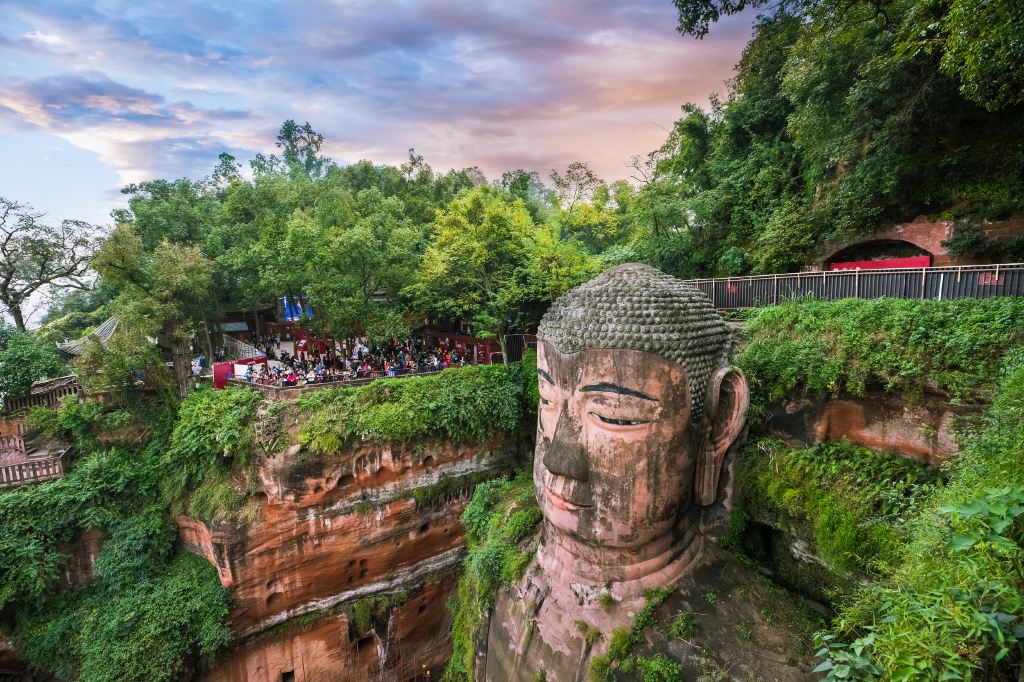
The Leshan Giant Buddha, also known as the Lingyun Giant Buddha, is situated on the cliff of Qiluan Peak on Lingyun Mountain at the confluence of the Min River, Qingyi River, and Dadu River in Leshan, Sichuan. It is a colossal seated stone statue of Maitreya carved during the Tang Dynasty, standing approx. 70 m tall, with a single instep spacious enough to accommodate over a hundred people. Legend has it that the turbulent waters at the confluence once frequently capsized passing boats. To calm the currents, the monk Haitong of Lingyun Temple initiated the carving of the Buddha. Over several generations, craftsmen continued the construction, which took approx. ninety years to complete. On the cliff to the right of the Buddha, an inscription from the Tang Dynasty titled "Jiazhou Lingyun Temple Great Maitreya Stone Statue" remains to this day, revealing its original name—the Great Maitreya Stone Statue of Jiazhou Lingyun Temple. The common route to visit the giant Buddha is to first arrive at Lingyun Temple beside the Buddha's head, then descend along the winding Jiuzhaigou plank road built against the cliff. View the Buddha's spiral hair buns and robe folds up close, and reach the platform at the Buddha's feet to look up at the full figure. Only then can one truly appreciate the grandeur of "a mountain being a Buddha, and a Buddha being a mountain." Lingyun Temple has continuous incense offerings, and many travelers also join their palms here to pray for blessings. For a different perspective, take a boat cruise or view from the riverside of Leshan ancient city: the continuous mountain outlines of Wuyou Mountain, Lingyun Mountain, and Guicheng Mountain resemble a giant reclining Buddha facing upward, with the grand Buddha seated precisely at its chest—creating the marvel of "Buddha within Buddha." The river view also captures the grand Buddha's full profile alongside the scenery of three rivers, making it especially effortless for travelers with limited stamina or those seeking panoramic shots.China · Leshan

Bipeng Valley
Bipeng Valleyis located in Sologou, Putou Township, Li County, Aba Prefecture. It is famous for its beautiful natural scenery and intact natural ecological landscape. It is a well-known red leaf viewing site in China. If you are not an outdoor player who hikes, it is relatively easy to visit Bipenggou. After buying a ticket at the gate of the Attraction, you can take the Attraction sightseeing bus through Longwanghai Lake and Namu Lake to the Shanghaizi Reception Center. The whole journey is about 30 kilometers. There are snow-capped mountains along the way, and there are many red leaf viewing spots. After arriving at Shanghaizi, you can take a short rest, then you can continue to reach Panyang Lake on foot or take a paid battery car, and return the same way after the tour. You can also choose to hike in Shanghaizi to Yanziyanwo, which is about 10 kilometers long and the road conditions are good. Bipeng Valleyhas its own characteristics in each season, but the recommended time to visit is from September to October in autumn. At this time of year, the maple leaves in the gully are as bright red as fire, and the lake and mountains, together with the surrounding snow-capped mountains, form a charming picture, which is colorful and very artistic. Generally, you don't need to stay overnight when visitingBipeng Valley. Just remember to bring some drinks and high-calorie foods, such as chocolate and beef jerky, when you enter the gorge.China · Li County
Experiences you can't miss in Daying
Featured Day tours in Daying
View all Day tours
5.0/5
· 1 reviewFree cancellation
Instant confirmation
9% off
Limited-time sale
FromNZD 229.07NZD 254.52
![1-day private charter tour to Anyue stone carvings [Yuanjue cave/Qianfo village/Tapo/Pilu cave - admission ticket not included]](https://ak-d.tripcdn.com/images/0350b12000k2dyf37CEE4_C_568_320.jpg?_fr=wc)
5% off
Limited-time sale
FromNZD 694.13NZD 730.67
![Departing from Chengdu: [Song dynasty aesthetics masterpiece + black myth wukong filming location] pickup service included | private charter](https://ak-d.tripcdn.com/images/0353312000qz9lm0dB8B9_C_568_320.jpg?_fr=wc)
5% off
Limited-time sale
FromNZD 761.00NZD 801.06
5% off
Limited-time sale
FromNZD 347.07NZD 365.34
5% off
Limited-time sale
FromNZD 289.22NZD 304.45

5% off
Limited-time sale
FromNZD 404.91NZD 426.23
Free things to do in Daying
Dead Sea of China
Daying · 1.2km from downtownDujiangyan Scenic Area
China · DujiangyanImmediate access, Book now for todayChengdu Du Fu Thatched Cottage Museum
China · ChengduImmediate access, Book now for today, Cancel anytimeSanxingdui Museum
China · GuanghanMount Qingcheng
China · DujiangyanImmediate access, Book now for todayChengdu Wuhou Shrine Museum
China · ChengduImmediate access, Book now for todayMount Emei
China · Emeishan CityImmediate access, Book now for today, Cancel anytimeHongya Cave
China · ChongqingLeshan Giant Buddha
China · LeshanImmediate access, Book now for todayBipeng Valley
China · Li CountyBook now for tomorrow, Cancel anytime
More ways to travel from Daying
Private Tours in Daying
View More Private Tours in Daying


Group Tours in Daying
View More Group Tours in Daying




What travellers say about Daying

最美不过蓝天2 January 2026
4.0
The Dead Sea of China is located in Daying County, Suining City, within the Sichuan Central Fold Belt of the Neocathaysian Sichuan Subsidence Zone. The ancient salt lake exists 3,000 meters underground and covers an area of approximately 700 square kilometers. The brine in the lake is the sole source of water replenishment for the Dead Sea of China.
Dead Sea of China

Anonymous user14 October 2026
5.0
Definitely recommend booking tickets through trip.com made it way easier to get the tickets and scan through. Huge park.
Dujiangyan Scenic Area

铃兰61914 October 2026
5.0
I brought my parents here for a visit. The garden is huge, with a beautiful garden structure and design. The poet's calligraphy is still fresh and elegant, the bamboo forest is secluded, and the orchids are still fragrant. Climbing Wanfu Tower, you can see the entire city of Chengdu. It's so relaxing and enjoyable!
Chengdu Du Fu Thatched Cottage Museum

M52***5213 October 2026
5.0
Xiaoxiao, the guide at the Sanxingdui Museum, was extremely professional. Her explanations were ample in time and in-depth, covering not only the exhibits but also a great deal of archaeological knowledge, with excellent interactive elements. She brought the ancient Shu civilization to life in a vivid and easy-to-understand way. I learned a lot throughout the visit and highly recommend her. Her explanations of the Sanxingdui artifacts, casting techniques, and ancient Shu beliefs were clear, engaging, and the experience was excellent. I was very satisfied!
Sanxingdui Museum

M23***8813 October 2026
5.0
We climbed Mount Qingcheng for over three hours, visiting many Taoist temples. It was my first time experiencing Taoist culture so closely, and I definitely want to come back! We took the cable car down the mountain.
Mount Qingcheng

Q K Bill14 October 2026
4.0
Wuhou Shrine was not on my list, but when I took metro line 10 from airport terminal to my hotel, I read the name of the last station would be „Wuhou Shrine“ so i looked it up and read that ppl count it as ‘Must See‘ when in Chengdu. Directly booked ticket through Trip.com and went there today. I had to convert my online ticket at the ticket booth to a paper ticket just by showing them my passport (everything goes with the passport while in China 😉). After passing by the entrance gate, I also bought an audio guide (20 yuan but you will have to pay first another 100 yuan as deposit - when you are really interested in culture, this might be a thing (for me I think I would have been good with the english info signs that you can find here and there). And it is really beautiful shrines and temples. Very worth to be visited. It includes also two museums inside the venue and a park area. The place is next to Jinli street, which is known for its street food, theatre restaurants and craftwork
Chengdu Wuhou Shrine Museum

M25***0614 October 2026
5.0
Mount Emei is very large. It takes two hours to get there by car from the foot of the mountain, and then another half hour to walk to the cable car station. It was a bit tiring, but when we got to the top, we were lucky enough to see the sea of clouds, so it was worth the trip!
Mount Emei
Anonymous user5 October 2026
5.0
The Two Rivers Ferry is absolutely fantastic! The 15 yuan ticket is incredibly cost-effective! Here's a great route for families with kids: After visiting Jiefangbei and Kuixinglou, see Hongyadong during the day. If you're traveling with a 6-year-old and don't want to brave the crowds at Hongyadong at night, the stilted buildings during the day are just as beautiful. Afterward, take the Two Rivers Ferry to Danzishi, disembark, and explore Danzishi Old Street, Nanbin Road, and Xiahaoli. Then, take the light rail/bus or taxi back. The whole route is smooth and relaxing. The boat ride is novel and fun, and the kids especially loved it, remaining enthusiastic about exploring the shopping streets afterwards. At the pier, there's a large bowl of freshly cut watermelon for 10 yuan – watch it being cut right in front of you! It's sweet and refreshing. I highly recommend this route for families!
Hongya Cave

szfrank14 October 2026
5.0
I came to Leshan specifically for the boat tour of the Giant Buddha. I booked my tickets online, stored my luggage at the high-speed rail station, and took a taxi straight to Wuyou Temple Wharf. After visiting the temple, I returned the same way to retrieve my luggage and boarded the taxi. I'm very grateful to the shopkeeper at the station for her advice, telling us that if we wanted to take the boat recently, we should get off at the South Visitor Center and take a taxi directly to the underground parking lot on the way back, saving us a lot of trouble.
Leshan Giant Buddha
Anonymous user13 October 2026
5.0
This trip to Western Sichuan was such a wonderful surprise! The scenery along the way – from Mount Siguniang to Bipenggou, Jiuzhaigou, and Huanglong – was breathtaking; every shot was a masterpiece. Our tour leader, Mr. Ma, deserves a huge shout-out; he was attentive and responsible throughout the entire trip. Even with the many curves in Western Sichuan, he drove very steadily, giving us peace of mind. The accommodations were also great, offering excellent value for money compared to other options. Overall, it was a very comfortable and enjoyable trip, highly recommended!
Bipeng Valley


