
Things to do in Grosseto
Explore top experiences
Top 10 attractions in Grosseto


Cathedral of Santa Maria del Fiore
• Known as the main church of the Catholic Archdiocese of Florence and the third largest church in the world • Consisting of the main church, bell tower and baptistery, it is not only large in scale, but also a representative building of the entire early Renaissance • The cathedral has a 19th-century Gothic Revival-style facade. Its exterior is paved with marble blocks of different shades of white, green and pink. The colors are colorful and harmonious △ In 1982, the cathedral was listed as a World Cultural Heritage as part of the historical center of Florence. After entering the church, you can climb up to the dome from the small door on the side. You need to climb 463 steps, and then overlook the entire city of Florence. △ The bell tower of the church is a Gothic building, 85 meters high. It consists of a six-story square structure stacked upward into a column. The outer wall is paved with white marble, which is pure and elegant, bringing more momentum to the majestic church.Italy · Florence

Piazza del Duomo
Piazza del Duomo is located in the heart of the historic center of Florence, which was inscribed on the UNESCO World Heritage List in 1982. The square has been the city's religious center since the Middle Ages. In the late 13th century, surrounding residential buildings were demolished to build the new cathedral and bell tower, and it was gradually expanded over the following centuries to its current size. The square brings together three iconic buildings: theCathedral of Santa Maria del Fiore, Giotto's Bell Tower, and The Baptistery of San Giovanni. Together, they form the "Cathedral of Santa Maria del Fiore complex," showcasing the evolution of architectural art in Florence from the Middle Ages to the Renaissance. The dome designed by Brunelleschi stands over 90 m high and is a striking visual focal point on the square's skyline. Historic buildings such as the Archbishop's Palace, the Cathedral Museum, and the Bigallo Museum are also located around the square. Standing in the center of the square and looking around, the facades of buildings from different eras and styles complement each other, making it a key location for experiencing the urban landscape of Florence.Italy · Florence

Pantheon
The Pantheon is a well-preserved building in ancient Rome, with a history of more than 2,000 years. Artist Raphael, Roman emperor Vittorio Emmanuel II and Wimble I rest here. The Pantheon was built by Agoriba, the son-in-law of the first emperor of the Roman Empire, Octavian, to worship the gods on Mount Olympia. Luo praised it as "Angel's Design". The Pantheon is located in the center of Rome. Its vestibule is Piazza Rotonda. There is a fountain erected with a tall steeple stele. The base of the stele is carved with scenes from ancient Roman mythology. The main building structure is simple and clear. It is a huge cylinder of equal width and height, covered with a semi-circular dome. There are no windows inside, and there are statues of gods all around. There is a large circular hole with a diameter of 8.9 meters on the top, which is the lighting point of the Pantheon. The light leaks from the top and changes the angle of the light with the movement of the position of the sun, giving people a sacred and solemn feeling.Italy · Rome

Colosseum
•This was the place where gladiators fought for their lives, prisoners on death row struggled with hungry lions, and it was also the great symbol of eternal Rome •Take in the magnificent architecture and imagine epic battles that once took place here •Imagine the bustle of the marketplace, the intrigue of political debates, and the opulence of imperial residences △ The Colosseum was built on the site of the magnificent Dumus Aurea and was completed in 80 AD. But with the decline of the Roman Empire in the 6th century AD, the Colosseum was gradually abandoned and became overgrown. Since then, the Colosseum has been damaged by earthquakes many times, and it has even become a source of stone and marble for builders. Nowadays, only the incomplete skeleton of the Colosseum is left in front of people, but you can still get a glimpse of the style of that day. △ From the outside, the Colosseum has four floors (including the underground). On the first floor, you can clearly see the maze-like building in the center of the Colosseum. The basements that were once the Colosseum housed the beasts and gladiators who were about to duel. If you want to see the underground part up close, you need to be led by a tour guide. △ The entire exterior wall of the Colosseum is made of limestone, with 80 arches (vormitori) on each floor, allowing spectators to quickly enter and take their seats. The recesses on the second and third floors were once filled with marble statues. The top of the wall is dotted with windows and slender Corinthian pilasters, and there are 240 wall columns to support the canvas canopy covering the Colosseum.Italy · Rome

Val d'Orcia
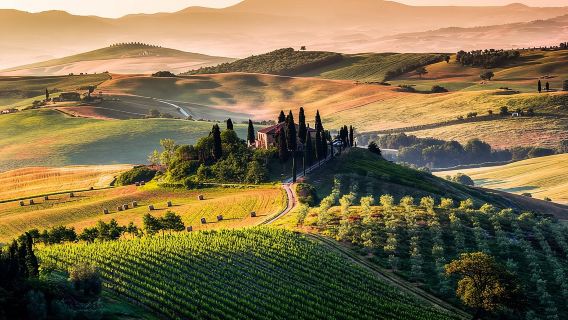
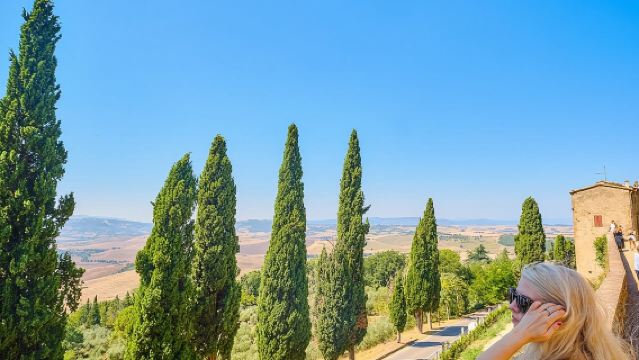
Val d'Orcia is named after the Orcia River and was inscribed on the UNESCO World Heritage List in 2004. This vast rural area is famous for its rolling hills, rows of cypress trees, vineyards, and olive groves, serving as a quintessential representation of the Tuscan landscape. UNESCO recognizes it as an exceptional example of the redesign of the natural landscape during the Renaissance, where the layout of farmland, the distribution of settlements, and the natural environment formed a harmonious and unique order. The valley unfolds along the ancient pilgrimage route, the Via Francigena, connecting medieval towns such as Montalcino, Pienza, San Quirico d'Orcia, and Castiglione d'Orcia. Cypress-lined paths, solitary farmhouses on hills, and the gully landscapes formed by wind and rain erosion on clay hills are all highly recognizable images of Val d'Orcia. The valley also produces Brunello wine and Pienza pecorino cheese, making it a pleasant destination for sightseeing.Pienza · 56km from Grosseto

Leaning Tower of Pisa
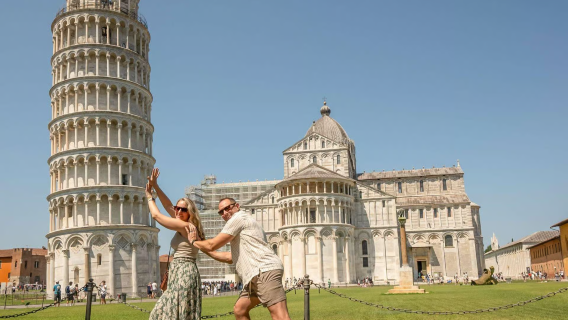
The Leaning Tower of Pisa is an iconic building in Italy and a wonder in the history of world architecture. It was selected as a world cultural heritage by the United Nations Educational, Scientific and Cultural Organization. The Leaning Tower of Pisa is actually an independent bell tower of the Cathedral of Pisa, located in the central square of Pisa, the Miracle Square. The square is full of people, and it is common for tourists to stretch out their arms and pose for pictures with the Leaning Tower in all kinds of whimsical shapes. Leaning Tower Construction History and Leaning Reasons The Leaning Tower of Pisa is more than 20 meters away from the cathedral. It has a cylindrical appearance and is made of white marble. The year of construction engraved in Latin on the base of the tower was 1174, and it was completed in 1350; but in fact, the calendar used in ancient Pisa was one year earlier than the Gregorian calendar, so the year of construction of the Leaning Tower of Pisa was 1173. It is said that the Leaning Tower of Pisa was built with six trophies brought in by the Pisa fleet. The Leaning Tower of Pisa is 54.5 meters high and 16 meters in diameter. In the early stages of construction, the leaning tower tilted an average of 1 mm per year, and construction was temporarily suspended. Most believe the slope is due to uneven foundations and soft soil layers. In 1998, workers wrapped cables on the third tier, attached it to the frame, and removed some of the deposited soil to the north to bring the leaning tower into equilibrium. There are 213 arches on each floor of the leaning tower overlooking the city of Pisa. There are 294 spiral steps in the tower, for tourists to climb the tower and overlook the scenery of the whole city. Some steps are slippery, so you need to pay attention to your feet. In summer evenings, you can enjoy the beautiful night view of Pisa from the Leaning Tower. The experience of entering the Leaning Tower is very special. When you walk down the very narrow spiral staircase, you will feel as if you are on a boat. When you reach the top of the tower, the vision is suddenly clear. There is glass at the top of the tower, because the interior of the tower is hollow, so the ground floor can be seen directly through the glass. The process of climbing the tower is now limited by time and number of people. You need to go to the ticket office to book tickets in advance, or if you want to avoid long queues, you can buy tickets on the official website and print them out. Ticket holders to the summit should gather at the designated place in advance. The staff will first introduce the history of the Leaning Tower for 5 minutes, and then a special person will lead the team to climb the tower. Only 15 people are arranged in each batch, and the stay on the tower shall not exceed 30 minutes. If you feel that the Leaning Tower is too expensive, you can walk around the Leaning Tower, or visit the churches and museums on the square. There are many pedestrian streets near the scenic spot, and various handicrafts are sold in small shops.Italy · Pisa

Cassero Senese of Grosseto
Grosseto · 397m from downtown

Piazza del Duomo
The Miracle Square is the top priority of visiting Pisa. The four major buildings on the square - the Cathedral of Pisa, the Baptistery, the Leaning Tower of Pisa and the cemetery are all artistic masterpieces in the history of architecture. The square was one of the centers of the essence of medieval art and had a profound influence on subsequent architectural design, and was inscribed on the UNESCO World Heritage List in 1987. The square takes its name from a description in a novel by the Italian writer and poet Gabriel D'Annunzio. The Pisa Cathedral in the center of the Pisa Cathedral Square was built in the 12th century AD and is a masterpiece of medieval Romanesque architecture. The mosaic decoration inside the church is mixed with Byzantine style, forming its unique "Pisa Romanesque style". Opposite the Baptistery of Pisa Cathedral is the Baptistery, which mixes Romanesque and Gothic styles. You can visit the middle of the Baptistery along the spiral staircase inside the Baptistery. The cylindrical structure, double dome and white marble make the interior of the baptistery even more beautiful. Leaning Tower of Pisa Behind the Leaning Tower of Pisa is the well-known Leaning Tower of Pisa, which itself is the bell tower of the cathedral. In the early stage of construction, the leaning tower tilted an average of 1 mm per year, and the work was stopped for a while, and the repair work has continued to this day. The rectangular building next to the Pisa Cemetery Church is the Pisa Cemetery. The tombstones, sculptures and frescoes on the cloister are also worth seeing. In addition, there is a tourist rest area on the large lawn of Miracle Square, where you can take various photos with the Leaning Tower of Pisa, buy souvenirs and snacks.Italy · Pisa

Pienza
Pienza is situated on a ridge in the Val d'Orcia in Tuscany and is a Renaissance town reborn thanks to a pope. Pius II was born here, and after being elected pope, he asked the Florentine architect Bernardo Rossellino to rebuild his hometown according to the Renaissance concept of an "ideal city," and renamed the town Pienza after his own papal name. The trapezoidal Piazza Pio II is surrounded by the cathedral, Palazzo Piccolomini, the Bishop's Palace, and the town hall. Here, the humanist urban ideal was transformed into a complete layout, and the appearance of the old town has been preserved largely as it was. When visiting, feel free to slow down: the cathedral features a rare, bright hall church layout, and it houses altarpieces from the Sienese school; the back of Palazzo Piccolomini faces an Italian garden with a three-story loggia, and from the railing, you can see the rolling wheat fields and cypresses of the Val d'Orcia, as well as Mt Amiata in the distance; the stone well in the square, engraved with the Piccolomini family coat of arms, was once imitated throughout Tuscany. Another signature of the old town is Pecorino cheese, and you can find varieties with different levels of aging in the cheese shops along the street; follow the alleys to the city walls, and you can overlook the entire valley and its countryside.Pienza · 57.8km from Grosseto

Pitti Palace
As the royal palace of Florence, the Pitti Palace was once the residence of the Grand Dukes of Tuscany, kings, and emperors, with the aura of rulers permeating every corner. [Massive Museum Complex] : Spanning approximately 32,000 square meters, it stands as one of Florence's largest museum complexes, akin to an indoor city of art. The Palatine Gallery houses masterpieces by artistic giants such as Raphael, Titian, and Rubens, with Raphael's "Madonna of the Chair" and "female with a Veil" being the crown jewels of the collection.Italy · Florence
Experiences you can't miss in Grosseto
Featured Day tours in Grosseto
View all Day tours
4.6/5
· 24 reviewsFree cancellation
Book now for tomorrow
5% off
Limited-time sale
FromPKR 17,602.84PKR 18,529.31
Free cancellation
Book now for tomorrow
5% off
Limited-time sale
FromPKR 26,404.27PKR 27,793.97
Free cancellation
63 travellers saved
FromPKR 16,813.65
FromPKR 29,852.79
FromPKR 20,588.14

FromPKR 28,823.40

Free cancellation
52 travellers saved
FromPKR 26,078.31

FromPKR 17,843.05
Featured Food & drink in Grosseto
View all Food & drink
Free cancellation
Book now for tomorrow
5% off
Limited-time sale
FromPKR 14,375.65PKR 15,132.27
4.3/5
· 40 reviewsFree cancellation
Book now for tomorrow
FromPKR 11,070.08
FromPKR 21,503.46
4.6/5
· 15 reviewsFree cancellation
Book now for tomorrow
FromPKR 7,881.10
5.0/5
· 37 reviewsFree cancellation
Book now for tomorrow
37 consecutive positive reviews
FromPKR 12,293.63
Free cancellation
Book now for tomorrow
FromPKR 23,012.13
Featured Cultural experiences in Grosseto
View all Cultural experiences
FromPKR 4,632.33
Free cancellation
Book now for today
FromPKR 2,470.58

Free cancellation
Book now for tomorrow
20% off
Limited-time sale
FromPKR 1,603.40PKR 2,004.26
Featured Outdoor experiences in Grosseto
View all Outdoor experiences
4.7/5
· 1k reviewsFree cancellation
56 consecutive positive reviews
FromPKR 28,999.77

5.0/5
· 1 reviewFree cancellation
Book now for tomorrow
5% off
Limited-time sale
FromPKR 17,309.46PKR 18,220.49

4.3/5
· 6 reviewsFree cancellation
Book now for tomorrow
5% off
Limited-time sale
FromPKR 17,309.46PKR 18,220.49
Free things to do in Grosseto
Cathedral of Santa Maria del Fiore
Italy · FlorencePiazza del Duomo
Italy · FlorenceVal d'Orcia
Pienza · 56km from GrossetoPiazza del Duomo
Italy · Pisa
Villa Borghese
Italy · RomePienza
Pienza · 57.8km from Grosseto
Piazza della Signoria
Italy · Florence
Cinque Terre
Italy · Monterosso Al Mare
Mouth of Truth
Italy · Rome
Piazza di Santa Croce
Italy · FlorenceBook now for tomorrow
What travellers say about Grosseto

Anonymous user22 September 2026
5.0
The queue was quite long, and you need to make sure you're in the correct line before you start queuing… Queues at tourist attractions in Europe often consist of several separate lines with unclear signage. I didn't choose to climb the bell tower or the dome, but the museum included in the ticket is worth a good look; personally, I felt the environment was quite nice.
Cathedral of Santa Maria del Fiore

Blessed by God28 September 2022
5.0
such a lovely place, the duomo or cathedral is very big that I cannot take a picture of the whole cathedral. Even if I have seen it several times I always love to visit and see it again and again.
Piazza del Duomo

136***6910 October 2026
5.0
A large dome with a large skylight allows a beam of light to enter the hall, though there are no windows, and the beam changes position throughout the day.
The Pantheon, derived from Greek, means "temple of the gods." Located in the heart of Rome, Italy, it is one of the best-preserved ancient Roman buildings. Converted to Catholicism in 609 AD and named the "Church of Our Lady and the Martyrs," it escaped large-scale demolition during the Middle Ages.
Built around 27 BC by Agrippa to worship the Roman gods, the original building was destroyed by fire twice. The existing structure was mainly built between 118 and 128 AD, primarily during Hadrian's reign. The portico retains the Latin inscriptions from Agrippa's founding, but the building itself is not the original from 27 BC.
The most famous features are the circular space and the dome's apex. The front features a Corinthian portico, while the rear houses the massive circular nave. The dome is approximately 43.3 meters in diameter, and the height from the ground to the apex is also 43.3 meters, making the interior space nearly a perfect sphere. The opening, approximately 8.9 meters in diameter, known as the "Eye of the Dome," is the only source of light and strengthens the connection between the building and the sky. The walls are about 6 meters thick, and the dome is constructed of concrete, brick, and lightweight aggregate, thinning towards the top to reduce weight.
The Pantheon masterfully combined grand scale, geometric order, and engineering technology, later influencing St. Peter's Basilica, the U.S. Capitol, and numerous Neoclassical buildings. It also transformed from a pagan temple into a church and a national monument in Italy, where Raphael and several Italian kings are buried.
Pantheon

_TI***ch12 October 2026
5.0
This place is amazing. It is my second time to visit colloseum. Last year sept was my first visit and it was raining and this tine is perfect. The weather is wonderful . I love it
Colosseum

Todemmy29 October 2019
5.0
Orcia is located in the province of Siena in the Tuscany region of central Italy. Since the Middle Ages, this border region of Orcia has always been a must-go place for pilgrims on their way to Rome. There are countless hostels, hotels, hospitals and post stations in the valley. Over the centuries, it has received a large number of pilgrims and tourists, providing convenience for their travel.
Val d'Orcia

Mirelats14 July 2026
5.0
Highly Recommended: A Beautiful Day in Pisa with My MomVisiting the Leaning Tower of Pisa with my mom was an absolute dream. The historic Piazza dei Miracoli is stunning, and climbing the tower is highly recommended for the incredible views over Tuscany.Quick Tip: Ticket lines are incredibly long. We booked our fast-track timed-entry tickets through the Trip.com app before arriving, which made our visit completely stress-free and smooth. It is a must-do when traveling in Italy!
Leaning Tower of Pisa

SHANE LIM MY21 June 2026
5.0
The place was extremely beautiful. This is the first time ever I travel to Europe so I love the whole experience. Surely recommend
Piazza del Duomo

Rosanna_19 July 2023
5.0
this is one my to go place in Toscane! definitely the best percorino cheese I have ever had in my luge! can’t wait to go back!
Pienza

蓝篮~4 April 2026
5.0
It's worth a visit. Although I don't know much about Florence, I just wanted to check it off my list and get a feel for it. I recommend splitting your time between visiting the Pitt Palace and the Uffizi Gallery. You can go to the Pitt Palace around 8 am and spend most of the day exploring it at your own pace. Because of time constraints, we didn't get to see much of the Boboli Gardens. Our accommodation near the train station was quite convenient. This was my second time in Florence, and I'd probably come back for a third time if I had the chance.
Pitti Palace


