【Indonesia Tourist Visa Complete Guide】Electronic Visa-on-Arrival / Single Entry Tourist Visa Application Process and Document Requirements

Contents
- What is the difference between Indonesian Electronic Visa-on-Arrival and Single Entry Tourist Visa?
- Duration and validity
- Eligible Countries
- Countries Requiring a Calling Visa
- Difference in required documents
- What do you need to apply for Indonesia Electronic Visa-on-Arrival?
- What do you need to apply for Indonesia Single Entry Tourist Visa?
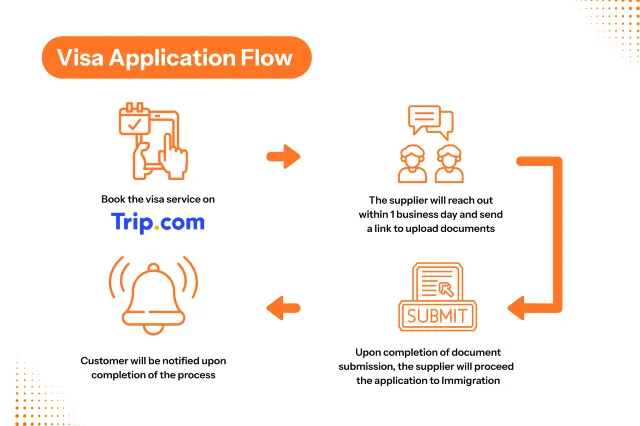
- Complete Application Process & Timeline for Indonesia Visa
- Customer Service, Holiday Schedule & Refund Policy
Show more
From the ancient temples of Borobudur to the emerald rice fields of Bali, the vibrant markets of Yogyakarta, and the pristine waters of Raja Ampat, Indonesia is one of Southeast Asia's most captivating destinations. Its rich cultural diversity, stunning volcanic landscapes, and world-class natural wonders draw millions of travelers every year.
Planning a trip to Indonesia means experiencing the contrast between Jakarta's urban energy and Bali's spiritual serenity, an adventure shared by explorers from around the globe.
But before you can set foot in this incredible archipelago, there is one essential step: obtaining the proper entry to Indonesian visa.
This guide walks you through the entire application process, from visa types and required documents to step-by-step procedures, so you can travel with confidence.
The two most common options for tourists coming to Indonesia are Electronic Visa on Arrival (e-VoA) and Single Entry Tourist Visa (C1). While both allow you to enter Indonesia, they serve different purposes, e-VoA covers a wider range of activities: including tourism, healthcare, government visits, business meetings, and transit. Whereas Single Entry Tourist Visa is strictly limited to tourism activities. Beyond purpose, they also differ significantly in duration, eligibility, documents, and application requirements.
The e-VoA allows a stay of up to 30 days, and can be extended once for an additional 30 days, giving you a maximum total stay of 60 days. The visa itself has a 90-day validity window, meaning you must enter Indonesia within 90 days of it being issued.
Single Entry Tourist Visa (C1), on the other hand, offers a significantly longer stay. It allows you to visit Indonesia for a total of 60 days, with the option to extend your visa 2 times, each extension adding another 60 days, meaning you may be eligible to stay in Indonesia for up to 180 days in total. For extension purposes, applicants must attend in-person to the immigration office closest to you. Once you leave Indonesia, the visa becomes invalid.
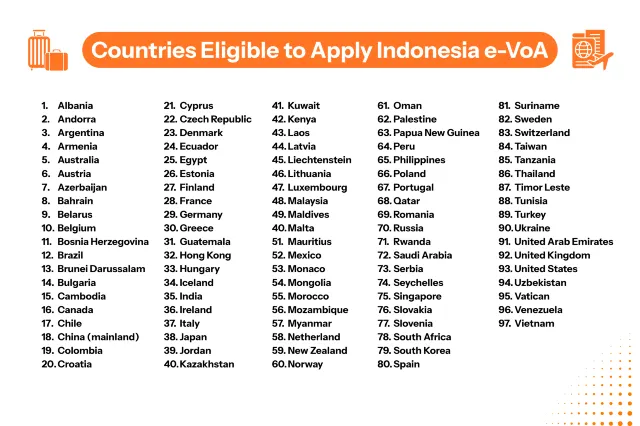
The e-VoA is available to a limited, specific group of nationalities. Per May 2026, passport holders from 97 countries can apply for e-VoA to Indonesia. Eligible countries are shown in the table below:
Single Entry Tourist Visa (C1) has broader accessibility, it is available to most nationalities worldwide, making it the go-to option for travelers whose countries are not on the e-VoA eligibility list. However, it is not applicable for passport holders of Sri Lanka, Pakistan, Sudan and Bangladesh, as these nationalities have a differing application process.
Some nationalities are not eligible for either the e-VoA or standard Single Entry Tourist Visa application process and are categorized as Calling Visa countries. Single Entry Tourist Visa is for those who are still overseas and whose countries are not listed as Calling Visa countries. Nationals from Calling Visa countries must obtain a special visa reference through an Indonesian sponsor or immigration authority before their visa can be processed, an additional step that standard applicants do not need.
These countries include: Afghanistan, Guinea, North Korea, Liberia, Nigeria, Somalia and Cameroon (the list may change over time, so please check the Indonesian Immigration website for the latest updates.)
The two visas differ notably in how much documentation is required. We'll cover each document in full detail in the next section.
The e-VoA typically requires less time than Single Entry Tourist Visa, and no physical documents or appointment are required.
Essential Documents Needed for e-VoA application:
- Colored Photo 3 cm x 4 cm in red background
- Copy of your passport
- Return and onward flight ticket
Essential Documents Needed for Single Entry Tourist Visa application:
- Colored photo 3 cm x 4 cm in red background
- Copy of your passport
This service page's operational hours are Monday to Friday, 09:00 AM – 06:00 PM (Western Indonesia Time / WIB, UTC+7). Please note that response time and document review are conducted during operational hours only. For urgent visa applications, we strongly recommend avoiding submissions close to weekends or public holidays to prevent delays that may affect your travel schedule.
While this service is generally non-refundable, a conditional refund may be granted under specific conditions as outlined below:
- The operator will review your application after you make the booking.
- A 95% refund of the total payment will be issued if the operator determines that you are ineligible for the service, or if you withdraw before any documents are fully uploaded to the operator's system and no verification has been conducted.
- An 85% refund of the total payment applies if you cancel after the documents have been verified but before submission to the embassy or immigration authority. Please note that any additional services already processed by the operator (such as insurance, delivery, translation, or appointment booking fees) are non-refundable.
- Once the application has been submitted or is under decision, regardless of the outcome, the booking becomes non-refundable. While we ensure that all documents meet the required standards, the final decision rests solely with the respective embassy or immigration authority.
Popular recommendations

Best Couples Accommodations in Queensland
 Trip.com blog
Romantic Getaways in Queensland
Trip.com blog
FIFA Qatar World Cup 2022: Top 10 tourist attractions you can’t miss in Qatar
 Shell
Shell
FIFA Qatar World Cup 2022: 8 Stadiums and nearby recommended hotels
ShellPopular Attractions
Popular Ranked Lists
Recommended attractions at popular destinations


About




Site Operator: Trip.com Travel Singapore Pte. Ltd.